- AIpreneur Insights
- Posts
- When Smart Doctors Miss Obvious Things
When Smart Doctors Miss Obvious Things
The “looked-but-didn’t-see” problem explains why medical errors happen even to experienced professionals.

Umer Khan
March 16, 2026 • Estimated Reading Time: 6 minutes
In partnership with


Welcome, AI Entrepreneurs!
Medical errors rarely begin with incompetence.
More often, they begin with human cognition.
The way we process information.
The way we interpret patterns.
The way hindsight changes how events appear in retrospect.
Psychologists call these cognitive biases.
Clinicians experience them daily:
• “Looked but didn’t see” errors
• Hindsight bias after bad outcomes
• Change blindness in fast environments
And when these cognitive limitations intersect with documentation, workflow pressure, and legal scrutiny, the consequences can escalate quickly.
Understanding this chain is critical not just for patient safety, but for protecting clinicians themselves.
Because in medicine, mistakes are rarely just clinical.
They become legal narratives.
In today’s AIpreneurs Insights:
Spotlight of the Week: Anatomy of a Professional Error: From Cognitive Bias to Legal Liability
Become the Human in the Loop in Healthcare AI
Top 3 AI Business Search Trends of the Week
Top 5 AI Tools to Think Faster and Execute Better in 2026
Free Resource: The Human-in-the-Loop Healthcare AI Decision Guide


Anatomy of a Professional Error: From Cognitive Bias to Legal Liability
Explore how small cognitive blind spots can turn into major professional consequences.
This week’s infographic examines the psychological patterns behind many clinical mistakes. From the “looked-but-didn’t-see” phenomenon to hindsight bias and change blindness and how these human limitations can eventually intersect with legal accountability.

In fast-paced clinical environments, decisions are made under pressure, often with incomplete information. Even highly skilled professionals can overlook critical details or anchor too quickly on an initial diagnosis.
When errors occur, legal systems evaluate them through structured frameworks such as the four elements of negligence: duty, breach, causation, and harm.
This visual highlights the hidden chain linking cognition, clinical decision-making, documentation, and liability.
Understand why improving healthcare safety requires not only better systems—but also awareness of how the human mind makes decisions under pressure.
Book a call using my Calendly link.
Not subscribed yet?
Are you keeping up with the latest in AI for business and healthcare? Our newsletter is essential reading for anyone navigating the AI landscape. It’s free, and industry leaders from top companies like Google, Hubspot, and Meta are already on board.
Sign up for our newsletter with just one click—it's completely free!!!
Big News: Our Program Is Live!!!

AI is entering healthcare faster than most professionals expected.
But many clinicians are only learning how to use AI tools, not how to evaluate or supervise them.
That gap is risky.
My course helps healthcare professionals understand:
• how AI systems actually work
• how to critically evaluate AI outputs
• how to supervise AI tools safely
• how to combine clinical expertise with machine intelligence
Because the future of healthcare will belong to professionals who know how to operate as the human in the loop.
Check out the structured program HERE: https://www.umerkhanmd.com/buy_videoprogram
You Can't Automate Good Judgement
AI promises speed and efficiency, but it’s leaving many leaders feeling more overwhelmed than ever.
The real problem isn’t technology.
It’s the pressure to do more with less — without losing what makes your leadership effective.
BELAY created the free resource 5 Traits AI Can’t Replace & Why They Matter More Than Ever to help leaders pinpoint where AI can help and where human judgment is still essential.
At BELAY, we help leaders accomplish more by matching them with top-tier, U.S.-based Executive Assistants who bring the discernment, foresight, and relational intelligence that AI can’t replicate.
That way, you can focus on vision. Not systems.

1. ChatGPT Health Missed Hospital-Level Emergencies in Over Half of Cases
A new study has raised serious safety concerns about ChatGPT’s health advice feature, finding that the system frequently failed to recognize situations requiring urgent medical care. Researchers warn that inaccurate triage recommendations could potentially lead to dangerous delays in treatment.

The Details:
In a study published in Nature Medicine, researchers tested ChatGPT Health using 60 realistic patient scenarios and nearly 1,000 model responses generated under different conditions.
The AI system under-triaged more than 51% of cases that required immediate hospital care, often recommending patients stay home or schedule routine appointments instead.
The model also struggled with sensitive scenarios such as suicidal ideation, where safety warnings sometimes disappeared depending on unrelated information like lab results.
Experts say such inconsistencies could create a false sense of security, potentially delaying lifesaving treatment or increasing liability risks for AI developers.
Why it Matters:
AI health assistants are increasingly being used by millions of people seeking quick medical advice online. While these tools promise accessibility and convenience, failures in triage or crisis detection highlight the risks of relying on AI for medical guidance without clear safety standards, auditing, and human oversight.
Find out more about it here: https://www.theguardian.com/technology/2026/feb/26/chatgpt-health-fails-recognise-medical-emergencies?utm_source=chatgpt.com
2. Why Some AI Startups Are Selling Equity at Two Different Prices
As competition to invest in AI startups intensifies, some companies are raising funding at two different valuations in the same round. The tactic allows startups to claim billion-dollar “unicorn” status while lead investors actually buy most of their shares at a lower price.

The Details:
In recent AI funding rounds, lead venture firms are investing part of their capital at a lower valuation and another portion at a higher valuation, effectively compressing two funding rounds into one.
For example, AI startup Aaru reportedly raised capital where the lead investor purchased a large stake at a $450M valuation, while additional investors entered the same round at a $1B valuation.
This structure creates an impressive headline valuation that signals market dominance, attracts talent and customers, and discourages competing investors from backing rival startups.
However, the blended valuation is actually lower, meaning the company must justify the higher “headline” price in future rounds or risk a damaging down round.
Why it Matters:
The strategy highlights how the AI investment boom is reshaping venture capital norms. While multi-tier valuations can help startups secure funding and build momentum quickly, they also raise expectations dramatically. If growth slows or the market cools, these companies may struggle to maintain their valuations — repeating patterns seen in previous tech bubbles.
Read more about it here: https://techcrunch.com/2026/03/03/why-ai-startups-are-selling-the-same-equity-at-two-different-prices/
3. Tech Billionaires Target Lawmaker Behind AI Transparency Law
Major AI companies and tech investors are spending millions to influence elections and shape the future of AI regulation. A high-profile congressional race in New York has become a focal point for the broader battle between Silicon Valley and lawmakers pushing for stronger AI oversight.

The Details:
A super PAC backed by Silicon Valley figures, including investors and AI executives, has raised $125 million to oppose candidates supporting stricter AI regulations.
One major target is New York Assembly member Alex Bores, who sponsored the RAISE Act, requiring large AI companies to publish safety plans and disclose major incidents.
Tech-backed political groups argue AI regulation should happen primarily at the federal level, while states have been introducing their own transparency and oversight laws.
The surge in tech funding reflects a broader trend, with AI companies and industry groups contributing tens of millions of dollars to political campaigns in recent election cycles.
Why it Matters:
AI is rapidly becoming one of the most powerful industries in the world, and the fight over how it should be regulated is moving from tech conferences into political campaigns. As billions of dollars flow into both AI development and political influence, the outcome of these policy battles could shape everything from worker protections to safety standards and national competitiveness in the global AI race.
Find out more about it here: https://techcrunch.com/2026/03/03/ai-companies-are-spending-millions-to-thwart-this-former-tech-execs-congressional-bid/
Stay tuned for more updates in our next newsletter!

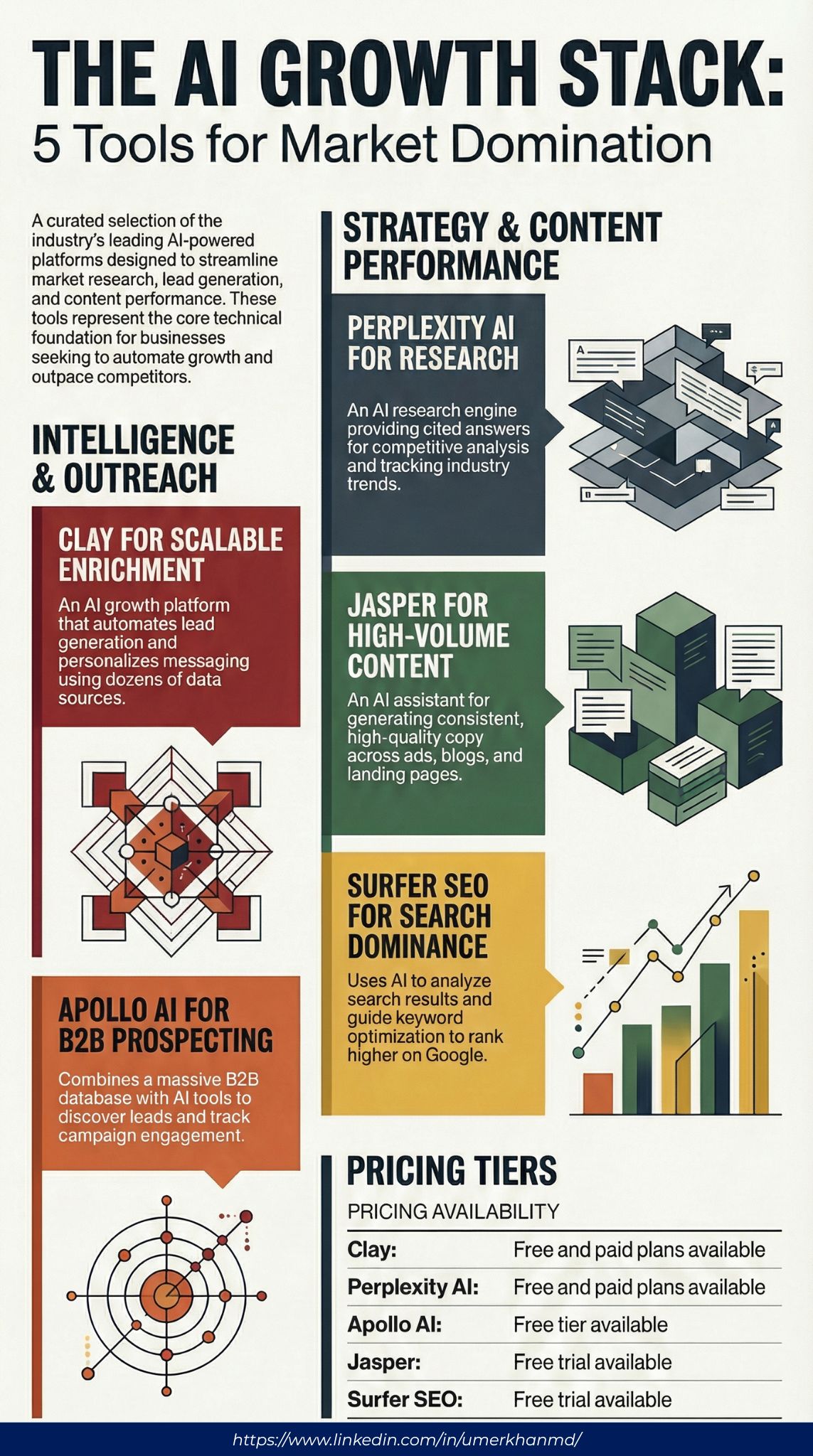
Top 5 AI Tools to Dominate Your Market
1. Clay
Clay is a powerful AI-driven growth platform used for lead generation, enrichment, and outreach automation. It helps businesses identify high-value prospects, gather data from dozens of sources, and personalize messaging at scale. Free and paid plans available.
2. Perplexity AI
Perplexity acts as an AI research engine that delivers answers with citations from real sources. Excellent for competitive analysis, market research, and staying ahead of industry trends. Free and paid plans available.
3. Apollo AI
Apollo combines AI-powered prospecting with a massive B2B database. It helps teams discover leads, automate outreach campaigns, and track engagement to close deals faster. Free tier available.
4. Jasper
Jasper is an AI marketing assistant designed for generating high-quality content across ads, blogs, landing pages, and email campaigns. Great for teams that want consistent messaging and faster content production. Free trial available.
5. Surfer SEO
Surfer SEO uses AI to analyze search results and guide content creation that ranks higher on Google. It provides keyword optimization, content scoring, and competitor insights to dominate search traffic. Free trial available.

𝐘𝐨𝐮 𝐭𝐡𝐢𝐧𝐤 𝐝𝐨𝐜𝐮𝐦𝐞𝐧𝐭𝐚𝐭𝐢𝐨𝐧 𝐢𝐬 𝐭𝐲𝐩𝐢𝐧𝐠.
𝐈𝐭’𝐬 𝐚𝐜𝐭𝐮𝐚𝐥𝐥𝐲 𝐦𝐞𝐦𝐨𝐫𝐲 𝐮𝐧𝐝𝐞𝐫 𝐬𝐭𝐫𝐞𝐬𝐬.
The patient spoke for fifteen minutes.
You listened.
You decided.
You examined.
Then hours later, you’re asked to replay it.
What did they say first?
When did the pain start?
Was the weakness subtle or obvious?
Did the family mention that detail before or after the exam?
Documentation isn’t just typing what happened.
It’s rebuilding the encounter from fragments.
From short-term memory.
From quick notes.
From mental snapshots taken between interruptions.
Meanwhile the pager goes off.
Another patient is waiting.
The shift keeps moving.
Memory under pressure isn’t perfect.
So we compensate.
Longer notes.
More imported data.
Extra phrasing to feel safe.
Because if you can’t remember every nuance,
You over-document everything.
That’s why documentation feels heavy.
It’s not clerical work.
It’s cognitive replay.
And when AI is done right,
it doesn’t replace judgment.
It actually protects memory.
It captures the conversation in real time.
It reduces the need to reconstruct.
It lets the brain focus on thinking... not remembering.
The future of documentation isn’t faster typing.
It’s fewer forced replays.
Because medicine should demand expertise.
Not perfect recall under pressure.
The Future of AI in Marketing. Your Shortcut to Smarter, Faster Marketing.

This guide distills 10 AI strategies from industry leaders that are transforming marketing.
Learn how HubSpot's engineering team achieved 15-20% productivity gains with AI
Learn how AI-driven emails achieved 94% higher conversion rates
Discover 7 ways to enhance your marketing strategy with AI.
Want to work with Me? Here’s how:
I help companies with AI integration and with other technology and development requirements. Book a Strategy Call. (https://calendly.com/dr-umerkhan/available-for-meeting)
Promote Your Product: I’ll share your product with my 15k followers on LinkedIn. Reply “promo” if interested.
If you enjoyed this newsletter, please forward it to your friends and colleagues.
Follow me on LinkedIn, Youtube, and X/Twitter to see my latest content.
My Latest LinkedIn Posts

Stay Tuned
Stay tuned for more updates on AI trends, tools, and insights in our next newsletter.
Reply