- AIpreneur Insights
- Posts
- WARNING: 95% of AI Pilots Fail!
WARNING: 95% of AI Pilots Fail!
Most tools ignore workflow. That is why they collapse...

Umer Khan
February 23, 2026 • Estimated Reading Time: 13 minutes
In partnership with


Welcome, AI Entrepreneurs!
Healthcare AI does not usually fail because the models are weak.
It fails because it shows up in the wrong place, at the wrong time, in the wrong way.
Clinicians are forced to log into separate apps, re-enter data, and interpret black-box recommendations without context. Over time, they stop trusting the tool.
In today’s issue, I break down why workflow is the real deciding factor in whether healthcare AI succeeds or quietly disappears.
In today’s AIpreneurs Insights:
Spotlight of the Week: Why Workflow Is Everything in Healthcare AI
Become the Human in the Loop in Healthcare AI
Top 3 AI Business Search Trends of the Week
Top 5 AI Tools That Support Safe and Responsible AI Rollout in Healthcare
Free Resource: The Human-in-the-Loop Healthcare AI Decision Guide


Why Workflow Is Everything in Healthcare AI
This week’s infographic explains why 95 percent of generative AI pilots fail to show meaningful ROI.
The issue is not intelligence. It is integration.
When AI sits outside the EHR, requires extra clicks, or disrupts clinical flow, it adds friction instead of removing it. Even strong models fail if they are not embedded directly into how clinicians already work.

The best AI is almost invisible. It appears within the workflow, surfaces insights at the right moment, and reduces effort instead of adding steps.
This is especially true for tools like AI scribes. When deployed thoughtfully within existing documentation workflows, they reduce after-hours work and cognitive burden. When layered on top as a separate system, they create duplication and frustration.
If you are evaluating AI tools, the first question is not accuracy. It is workflow fit.
If you want to review whether an AI scribe or workflow tool fits your practice, we can walk through it together. You can book a call using my Calendly link.
Not subscribed yet?
Are you keeping up with the latest in AI for business and healthcare? Our newsletter is essential reading for anyone navigating the AI landscape. It’s free, and industry leaders from top companies like Google, Hubspot, and Meta are already on board.
Sign up for our newsletter with just one click—it's completely free!!!
Big News: Our Program Is Live!!!

Most AI failures in healthcare are workflow failures.
In Become the Human in the Loop in Healthcare AI, I teach clinicians and leaders how to evaluate AI tools based on real-world integration, not marketing claims.
You will learn how to map clinical workflows, identify friction points, assess readiness, and deploy AI in a way that improves outcomes instead of adding burden.
AI success in healthcare is not about finding the smartest model. It is about designing the right system around it.
Check out the structured program HERE: https://www.umerkhanmd.com/buy_videoprogram
Still searching for the right CRM?

Attio is the AI CRM that builds itself and adapts to how you work. With powerful AI automations and research agents, Attio transforms your GTM motion into a data-driven engine, from intelligent pipeline tracking to product-led growth.
Instead of clicking through records and reports manually, simply ask questions in natural language. Powered by Universal Context—a unified intelligence layer native to Attio—Ask Attio searches, updates, and creates with AI across your entire customer ecosystem.
Teams like Granola, Taskrabbit, and Snackpass didn't realize how much they needed a new CRM. Until they tried Attio.

1. Botched Procedures Raise Questions About AI in Medicine
As AI rapidly enters operating rooms and medical devices, reports of malfunctions, injuries, and product recalls are increasing. A Reuters investigation reveals growing safety concerns as regulators struggle to keep pace with the surge of AI-enabled medical technologies.

The Details:
After AI was added to a sinus surgery navigation device, FDA reports of malfunctions jumped from single digits to over 100, with at least 10 alleged patient injuries including strokes and skull punctures.
Lawsuits claim AI misidentified instrument locations during procedures, though manufacturers deny any causal link between the technology and patient harm.
More than 1,357 AI-enabled medical devices are now FDA-authorized, and researchers found a disproportionately high recall rate among them compared to traditional devices.
FDA AI review teams have reportedly been downsized, raising concerns that regulators lack the resources to properly vet increasingly complex AI-driven systems.
Why it Matters:
Healthcare AI is advancing faster than the oversight structures designed to regulate it. While AI promises better diagnostics and surgical precision, early warning signs suggest implementation may be outpacing safety validation. The central question is no longer whether AI will enter medicine — it already has — but whether regulatory frameworks, clinical trials, and accountability systems are robust enough to protect patients as the technology scales.
Find out more about it here: https://www.reuters.com/investigations/ai-enters-operating-room-reports-arise-botched-surgeries-misidentified-body-2026-02-09/?utm_source=chatgpt.com
2. AI Now Reads Brain MRIs in Seconds — With 97.5% Accuracy
Researchers at the University of Michigan have developed an AI system that can analyze brain MRIs in seconds, achieving up to 97.5% diagnostic accuracy. The system not only identifies neurological conditions but also prioritizes urgent cases like strokes and hemorrhages in real time.

The Details:
The AI model, called Prima, was trained on more than 200,000 MRI studies and 5.6 million imaging sequences, integrating patient histories and clinical context to mirror how radiologists interpret scans.
In testing across 30,000 MRI studies covering over 50 neurological diagnoses, Prima outperformed other advanced AI models and accurately flagged time-sensitive emergencies.
The system can automatically alert the appropriate subspecialist, such as a stroke neurologist or neurosurgeon, immediately after imaging is completed.
Researchers position Prima as a scalable solution to radiology shortages and diagnostic delays, particularly as global MRI demand continues to outpace specialist availability.
Why it Matters:
Radiology is facing rising imaging volumes and staffing shortages, creating delays that can directly impact patient outcomes. An AI co-pilot capable of instant triage could significantly reduce time-to-treatment for critical neurological emergencies. While still in early evaluation stages, systems like Prima hint at a future where AI doesn’t replace radiologists — but fundamentally reshapes how medical imaging workflows operate at scale.
Read more about it here: https://www.sciencedaily.com/releases/2026/02/260210005419.htm
3. Half of xAI’s Founding Team Has Now Walked Away
Two more xAI co-founders have exited the company, bringing total departures to six out of the original twelve founding members. As Elon Musk’s AI lab prepares for a potential IPO, the growing leadership turnover raises questions about internal stability and competitive momentum.

The Details:
Co-founders Yuhuai “Tony” Wu and Jimmy Ba announced their departures within 24 hours of each other, marking the latest exits from xAI’s original team.
Five of the six founder departures have occurred within the past year, including key infrastructure and research leaders.
While departures appear publicly amicable, xAI has faced product controversies, including Grok’s erratic outputs and issues tied to AI-generated deepfake content.
With an IPO pending and increasing competition from OpenAI and Anthropic, the company faces mounting pressure to maintain technical leadership.
Why it Matters:
Founder stability is critical in frontier AI labs where research continuity and culture drive competitive advantage. Losing half the original leadership team ahead of an IPO introduces uncertainty at a time when execution speed and model performance are everything. In the escalating AI arms race, retaining top talent may prove just as important as building the next breakthrough model.
Find out more about it here: https://techcrunch.com/2026/02/10/nearly-half-of-xais-founding-team-has-now-left-the-company/
Stay tuned for more updates in our next newsletter!

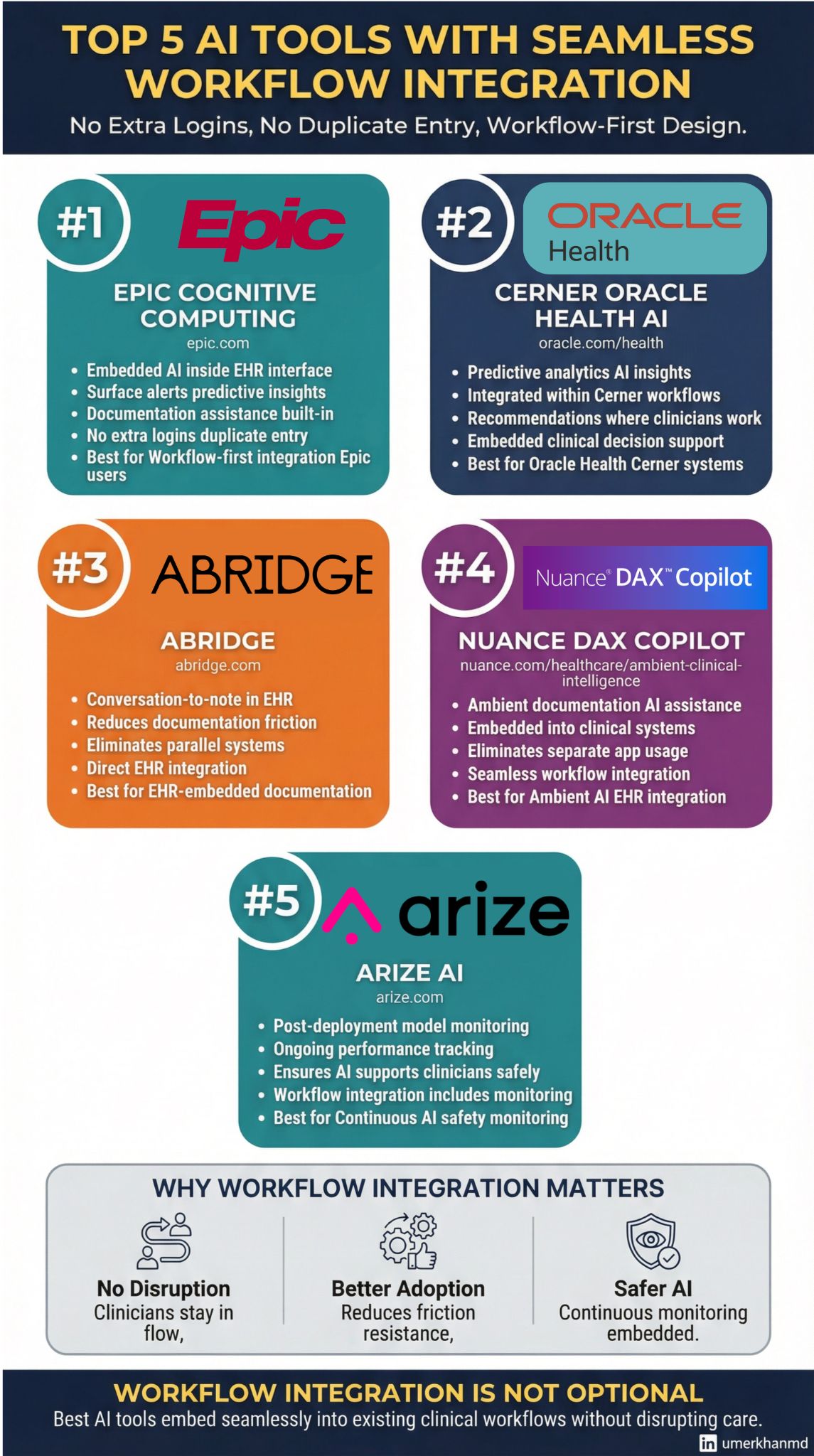
Top 5 AI Tools That Actually Embed Into Clinical Workflow
1. Epic Cognitive Computing / Embedded AI
Epic’s embedded AI tools surface alerts, predictive insights, and documentation assistance directly inside the EHR interface. No extra logins. No duplicate entry. Designed around workflow-first integration.
2. Cerner (Oracle Health) AI Tools
Oracle Health integrates predictive analytics and AI insights directly within Cerner workflows. Focused on embedding recommendations where clinicians already work.
3. Abridge
Abridge integrates conversation-to-note documentation directly into EHR systems. When deployed correctly, it reduces documentation friction instead of creating parallel systems.
4. Nuance DAX Copilot
Nuance DAX Copilot embeds ambient documentation and AI assistance into existing clinical systems. Designed to eliminate separate app usage.
5. Arize AI (Post-Deployment Monitoring)
Arize supports monitoring models after deployment. Workflow integration is not just about UI. It includes ongoing performance tracking to ensure AI continues to support clinicians safely.


𝐈 𝐝𝐢𝐝𝐧’𝐭 𝐠𝐞𝐭 𝐢𝐧𝐭𝐨 𝐦𝐞𝐝𝐢𝐜𝐢𝐧𝐞 𝐭𝐨 𝐬𝐩𝐞𝐧𝐝 𝐦𝐲 𝐛𝐞𝐬𝐭 𝐡𝐨𝐮𝐫𝐬 𝐭𝐚𝐥𝐤𝐢𝐧𝐠 𝐭𝐨 𝐚 𝐬𝐜𝐫𝐞𝐞𝐧.
AI was never meant to strip humanity out of healthcare.
It was meant to make room for it.
Room to listen without watching the clock.
To think without fighting the interface.
Care without carrying work home.
The goal was never to replace judgment
or automate responsibility.
It was to remove the noise that keeps clinicians
From doing the work ONLY HUMANS can do.
When technology works, it doesn’t dominate the encounter.
It quietly supports it.
👉 The patient feels seen.
👉 The clinician stays present.
👉 The system stays out of the way.
If AI is pulling attention away from care, something has gone wrong.
Not with the people using it, but with how it was designed and deployed.
The future of healthcare isn’t less human because of AI.
It’s MORE HUMAN because of what AI finally lets us stop doing.
Want to work with Me? Here’s how:
I help companies with AI integration and with other technology and development requirements. Book a Strategy Call. (https://calendly.com/dr-umerkhan/available-for-meeting)
Promote Your Product: I’ll share your product with my 15k followers on LinkedIn. Reply “promo” if interested.
If you enjoyed this newsletter, please forward it to your friends and colleagues.
Follow me on LinkedIn, Youtube, and X/Twitter to see my latest content.
My Latest LinkedIn Posts

Stay Tuned
Stay tuned for more updates on AI trends, tools, and insights in our next newsletter.
Reply