- AIpreneur Insights
- Posts
- Steal This AI Leverage Strategy Before Your Competitors Do
Steal This AI Leverage Strategy Before Your Competitors Do
If you’re still building sequentially, you’re already behind...

Umer Khan
March 23, 2026 • Estimated Reading Time: 5 minutes
Sponsored by


Welcome, AI Entrepreneurs!
The startup world just changed. Again.
The traditional Lean Startup cycle of Build–Measure–Learn is being replaced by something faster, sharper, and brutally efficient.
Prompt. Prototype. Proof.
AI has shifted leverage from engineering-heavy iteration to rapid adaptive execution. What used to take months can now happen in days.
If you are still thinking in terms of slow product cycles, you are already operating in the previous era.
In today’s AIpreneurs Insights:
Spotlight of the Week: The New Rules of Startup Leverage
Become the Human in the Loop in Healthcare AI
Top 3 AI Business and Healthcare Search Trends of the Week
Top 5 AI Tools to Build Faster Thank Your Competitors


AI: The New Rules of Startup Leverage
Discover why the most successful founders are no longer “building first.”
This week’s infographic breaks down the shift from lean experimentation to leverage-first execution. Instead of slow, sequential validation, AI-native startups now operate in parallel micro-tests, rapid prototypes, and real-time feedback loops.
Key shifts highlighted in this visual:
• The rise of the 3P Loop: Prompt, Prototype, Proof
• The move from point solutions to adaptive, AI-powered products
• Parallel validation replacing slow sequential testing
• Record-breaking AI investment and valuation growth
• The emergence of the “Minimum Adaptive Product”

AI is no longer just a feature inside a startup. It is the startup infrastructure.
Not subscribed yet?
Are you keeping up with the latest in AI for business and healthcare? Our newsletter is essential reading for anyone navigating the AI landscape. It’s free, and industry leaders from top companies like Google, Hubspot, and Meta are already on board.
Sign up for our newsletter with just one click—it's completely free!!!
Big News: Our Program Is Live!!!

AI gives you leverage.
But leverage without judgment creates chaos.
If you want to understand how to evaluate AI systems, measure real performance, manage risk, and lead adoption responsibly in healthcare, my course is built for you.
This program teaches clinicians, leaders, and founders how to:
• Understand AI metrics beyond hype
• Identify flawed AI claims
• Integrate AI into real workflows
• Stay indispensable in an AI-driven world
If you want to lead AI adoption instead of reacting to it, this is your next step.
Check out the structured program HERE: https://www.umerkhanmd.com/buy_videoprogram
Experts Would Invest $100,000 in This Alternative Now

A new Knight Frank report made an unexpected declaration. It revealed that 44% of family offices are investing more in residential real estate now. And, you don’t need to be Warren Buffet to see why.
Since 2000, residential real estate outperformed the S&P 500 by 70% in total returns. It’s the only asset that pays you to own it, grows while you sleep, and shields your gains from the IRS.
That’s why you need mogul. It’s a real estate platform that lets you invest in institutional-grade rental properties. You get monthly rental income, capital appreciation and tax benefits without a down payment or 3 a.m. tenant calls. In fact, over 20,000 investors have joined.
Here’s Why:
• Tax Benefits
• +7% annual yields
• 18.8% avg annual IRR
TLDR: You can invest in high quality real estate for a fraction of the cost. Why wait?
Past performance isn't predictive; illustrative only. Investing risks principal; no securities offer. See important Disclaimers

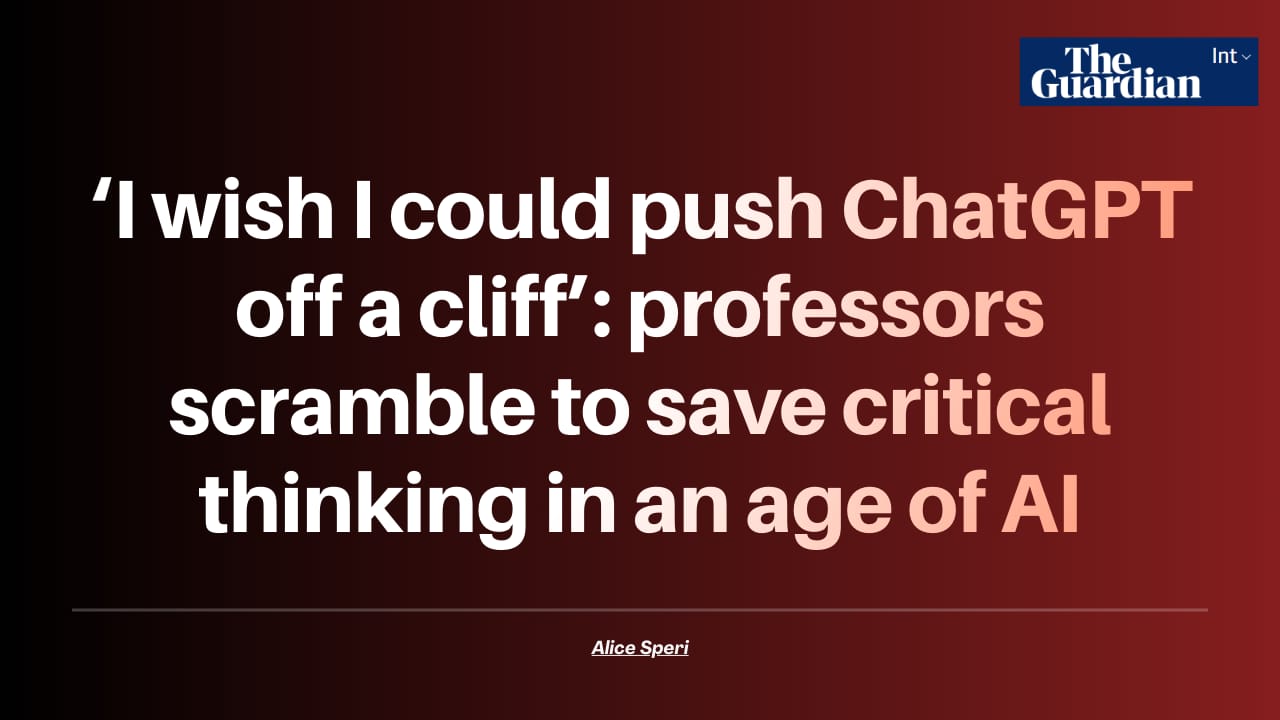
1. “I Wish I Could Push ChatGPT Off a Cliff”: Academia’s AI Crisis
As generative AI tools become embedded in student life, professors across the humanities are scrambling to preserve critical thinking, deep reading, and authentic writing. Many fear that overreliance on AI could fundamentally erode the intellectual foundations of higher education.
The Details:
Professors report that students increasingly rely on AI to complete assignments, even highly personal ones designed to require lived experience. In some cases, reflections and essays appear polished but lack originality, raising concerns that students are outsourcing thought itself.
A recent independent study found that as many as 92% of students admit to using AI for schoolwork. Faculty say this widespread use is transforming classrooms into spaces where instructors must police authenticity rather than foster inquiry.
Early research suggests AI use may weaken cognitive skills such as reading comprehension, synthesis, and analytical reasoning. Some educators warn that embracing AI without guardrails risks “self-lobotomizing” universities by replacing intellectual struggle with instant machine output.
Universities are taking mixed approaches: some ban AI outright, others integrate it into curricula, and many offer little guidance to faculty. Meanwhile, institutions are partnering with AI companies and investing heavily in AI infrastructure, even as humanities departments face funding cuts.
Professors worry about a future “bifurcation” in education, where elite students receive traditional, tech-light liberal arts training while others get AI-driven, vocational instruction. Critics argue this could deepen inequalities and reshape the purpose of higher education itself.
Why it Matters:
The debate over AI in education is no longer just about cheating. It’s about the role of human cognition in a machine-dominated era. As universities navigate productivity gains, cost pressures, and technological acceleration, they face a deeper existential question: Is higher education meant to optimize efficiency, or to cultivate distinctly human capacities like reflection, judgment, and imagination?
Find out more about it here: https://www.theguardian.com/technology/2022/dec/04/ai-bot-chatgpt-stuns-academics-with-essay-writing-skills-and-usability
2. Mira Murati’s AI Startup Lands Gigawatt-Scale Nvidia Partnership
AI startup Thinking Machines Lab, founded by former OpenAI CTO Mira Murati, has secured a multi-year partnership with Nvidia that includes a major investment and access to at least one gigawatt of next-generation computing power to train its AI models.

The Details:
Thinking Machines will deploy Nvidia’s upcoming Vera Rubin systems starting next year, securing computing capacity that industry executives estimate could cost up to $50 billion.
The startup previously raised about $2 billion at a $12 billion valuation and is reportedly seeking additional funding that could value it at tens of billions.
Nvidia continues expanding its role as both investor and chip supplier, backing major AI labs while providing the GPUs that power their models.
The company has faced recent leadership departures amid intense competition for top AI talent across leading labs.
Why it Matters:
The AI race is increasingly defined by access to massive computing infrastructure, and Nvidia’s central role in financing and supplying AI startups highlights how hardware dominance is shaping the next generation of AI power players.
Read more about it here: https://www.reuters.com/business/ai-startup-thinking-machines-clinches-capital-major-chip-supply-deal-nvidia-2026-03-10/
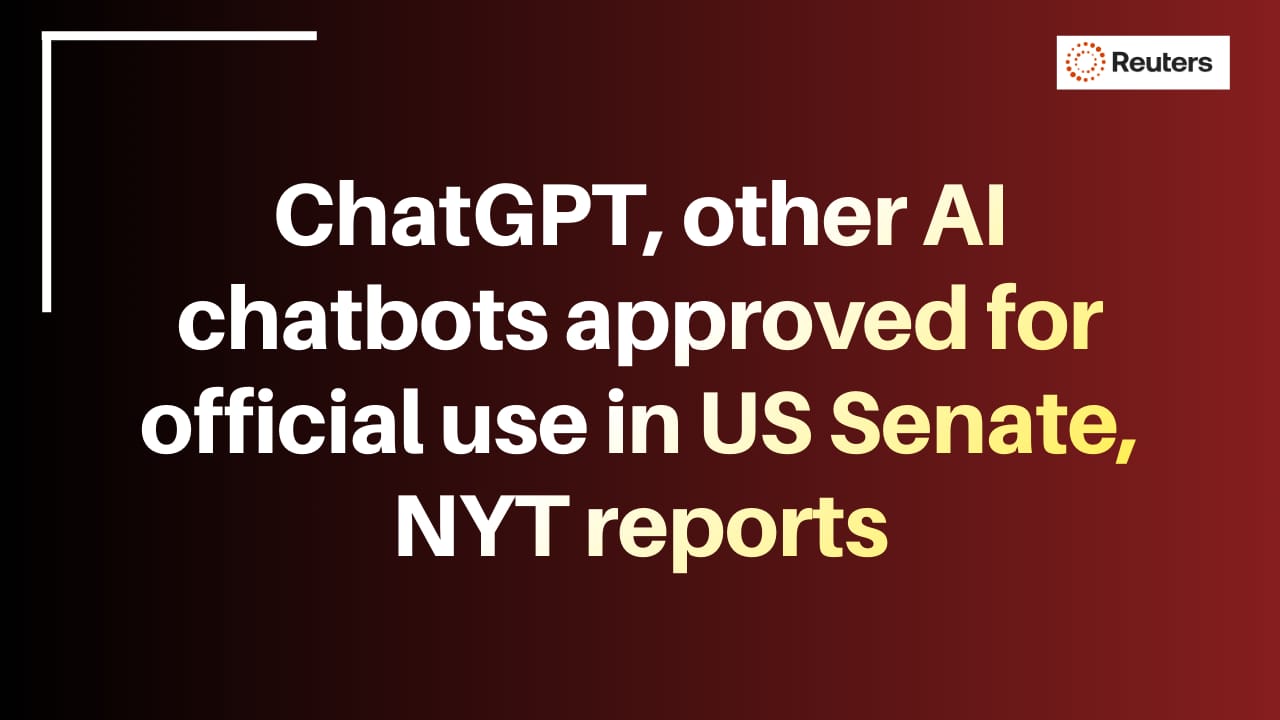
3. ChatGPT, Gemini, and Copilot Cleared for Senate Use
The U.S. Senate has officially approved the use of ChatGPT, Google Gemini, and Microsoft Copilot for aides, marking a major institutional step in the adoption of generative AI within federal government operations.
The Details:
A Senate memo confirms that staff are permitted to use ChatGPT, Gemini, and Copilot for official work.
The AI tools are already integrated into Senate-approved technology platforms.
The approval reflects growing institutional acceptance of generative AI in high-level government settings.
Representatives from Microsoft acknowledged the development, while Google and OpenAI did not immediately comment.
Why it Matters:
This move signals that generative AI is transitioning from experimental tool to operational infrastructure within government, potentially reshaping how legislation, research, and policy analysis are conducted at the federal level.
Find out more about it here: https://www.reuters.com/technology/chatgpt-other-ai-chatbots-approved-official-use-us-senate-nyt-reports-2026-03-10/
Stay tuned for more updates in our next newsletter!

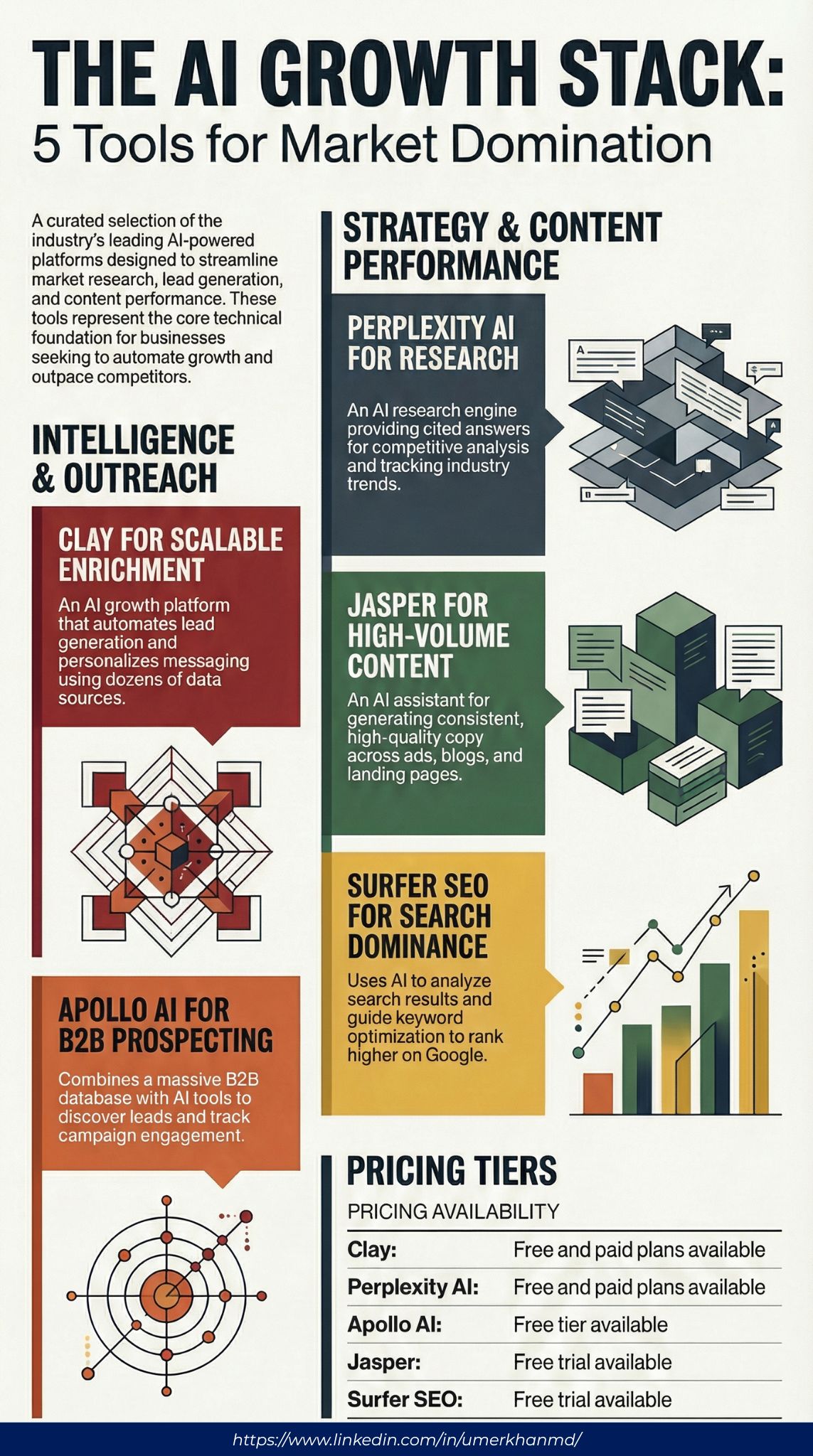
TOP 5 AI TOOLS TO BUILD FASTER THAN YOUR COMPETITION
1. Replit Ghostwriter
Replit Ghostwriter helps you generate, debug, and deploy code directly in the browser. Ideal for rapid MVP development and prototype testing without heavy infrastructure.
2. Cursor
Cursor is an AI-native code editor that lets you build software by prompting and refining code in real time. Perfect for founders building faster with fewer engineers.
3. Framer AI
Framer AI generates full landing pages and marketing sites from simple prompts. Excellent for testing positioning and messaging instantly.
4. Midjourney
Midjourney creates high-quality visuals for branding, product mockups, ads, and investor decks. Replace expensive design cycles with AI-assisted creative leverage.
5. Perplexity AI
Perplexity acts as an AI-powered research engine with citations. Ideal for competitive analysis, market sizing, and rapid industry intelligence.


𝐈𝐟 𝐢𝐭’𝐬 𝐧𝐨𝐭 𝐝𝐨𝐜𝐮𝐦𝐞𝐧𝐭𝐞𝐝, 𝐢𝐭 𝐝𝐢𝐝𝐧’𝐭 𝐡𝐚𝐩𝐩𝐞𝐧.
Your documentation is your legal defense.
Not your intentions.
Not your sincere effort.
Not how busy the shift was.
Your note.
In malpractice claims, the record becomes the story.
Did you explain the risks?
Did you consider the differential?
Did you reassess when the condition changed?
If the reasoning isn’t visible,
It’s assumed it didn’t exist.
𝐂𝐨𝐮𝐫𝐭𝐬 𝐥𝐨𝐨𝐤 𝐟𝐨𝐫 𝐟𝐨𝐮𝐫 𝐭𝐡𝐢𝐧𝐠𝐬:
Duty.
Harm.
Breach.
Causation.
The documentation connects them.
A vague note invites interpretation.
A copied-forward exam invites doubt.
An altered record destroys credibility.
Clarity protects you.
Structure protects you.
Honest documentation protects you.
This isn’t about writing longer notes.
It’s about writing clearer ones.
Because years later,
when memories fade and details blur,
The chart will speak.
Make sure it says what you actually did.
The Future of AI in Marketing. Your Shortcut to Smarter, Faster Marketing.

This guide distills 10 AI strategies from industry leaders that are transforming marketing.
Learn how HubSpot's engineering team achieved 15-20% productivity gains with AI
Learn how AI-driven emails achieved 94% higher conversion rates
Discover 7 ways to enhance your marketing strategy with AI.
Want to work with Me? Here’s how:
I help companies with AI integration and with other technology and development requirements. Book a Strategy Call. (https://calendly.com/dr-umerkhan/available-for-meeting)
Promote Your Product: I’ll share your product with my 15k followers on LinkedIn. Reply “promo” if interested.
If you enjoyed this newsletter, please forward it to your friends and colleagues.
Follow me on LinkedIn, Youtube, and X/Twitter to see my latest content.
My Latest LinkedIn Posts

Stay Tuned
Stay tuned for more updates on AI trends, tools, and insights in our next newsletter.
Reply